A Bag Contains N Marbles Two of Which Are Blue Hayley Plays a Game


Get the answer to your homework problem.
Try Numerade free for 30 days

University of Alabama at Birmingham
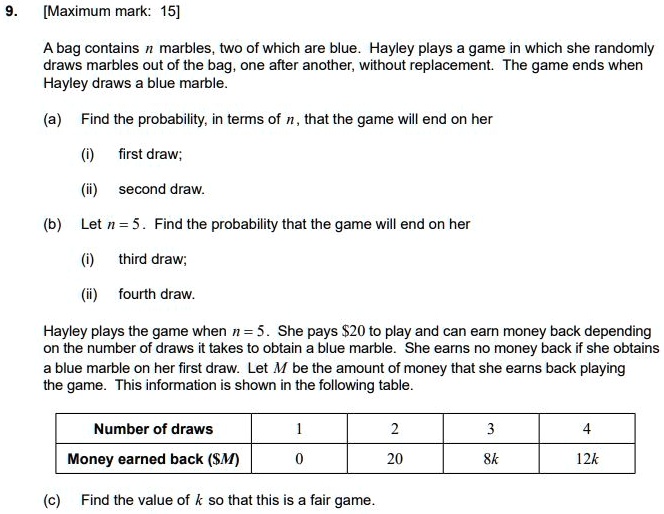
[Maximum mark: 15] bag contains marbles two of which are blue Hayley plays game in which she randomly draws marbles out of the bag; one after another; without replacement. The game ends when Hayley draws blue marble_ Find the probability; in terms of n that the game will end on her first draw; second draw: Let n = 5 . Find the probability that the game will end on her third draw; fourth draw: Hayley plays the game when n =5_ She pays S20 to play and can earn money back depending on the number of draws it takes t0 obtain blue marble_ She earns no money back if she obtains blue marble on her first draw: Let M be the amount of money that she earns back playing the game: This information is shown in the following table_ Number of draws Money earned back (SM) 12k Find the value of k so that this is fair game
Discussion
You must be signed in to discuss.
Video Transcript
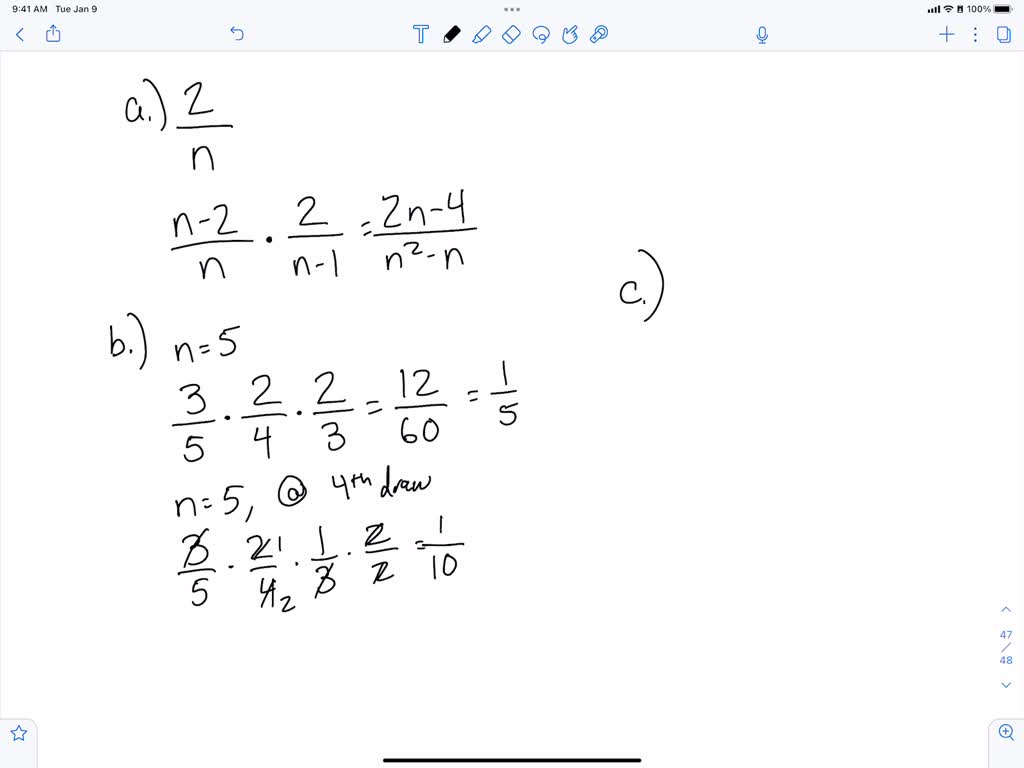
All right so in this problem we are dealing with a bag of marbles. We don't know how many to begin with. Two of which are blue. And she's playing the game in which she randomly draws marble out of the bag one after another without replacement. And the game ends when she draws a blue marble. So on part A. It wants us to fund. What is the probability that the game ends which is when she get a blue marble on her first draw? Well there's two blue marbles and there are in total marble so it would end um on The First Draw two Out of End Times. And then for the second part um That means that she is not going to get it right on her first draw. So her first draw she's gonna have one failure. Um And then she's not going to put it back. So then in the next tom Um they're still there'll be two blue marbles and then there's going to be in -1 marbles remaining. So that would be the probability that she gets it on the second trial. So the probability she gets it wrong is the total number of marbles minus two divided by n total number of marbles. And then she gets it right on the second time but now there's one less marvel because we did not um We did not replace it. So that comes out to be two in -4 over in squared minus in nothing. Let's see no nothing seems to simplify their so we'll leave it like that. So then for part B. What is the probability that she gets it? Only third draw? So that is now there is five. Now we have a number no more ends because we know what five is. So third draw that means she's going to get it incorrect first. So the first draw she has a three or five chance of getting incorrect. The second draw there's two not blue marbles and four total marbles. And then the third draw she's going to get it right now. There is only now there's two blue out of the total 36 sometimes to 12 um Over 60 which is 1/5. And for the fourth drawl getting it on the fourth draw so miss another mess another miss. And then after that all she has left is a blue marble. So to add it to um just simplifying here to make things a little bit easier. Um And then there's all those pretty much canceled. So that ends up being one out of 10 so one out of 10 chance that she um will Get it on the 4th on the 4th drawl. Um So actually in is not in is still five. Let me change that so and is still five. And then our success happens At the 4th drawl. And then part C. So we're given the probability distribution. Um And then the money earned back is what we're looking at. So the money earned back. I'll see actually let's I want to give myself some room here. So let's put it right down here some money earned back. She could get nothing If she gets on the first year all 20 if she gets it on the second eight K. And 12 K. On the 3rd and 4th draw. And then we gotta look at the probability of those different outcomes. So the probability of getting it on the first draw is 2/5. The probability of getting it on the um second draw would be one failure. Um Should actually be 3/5 Times 2/4 which is the second success which comes out to be 6/20, Just three out of 10 And then the other two we've already done which is 1/5 and 1/10. And then those all add up to a total probability of one. Now that is a fair game than the expected value as zero. You are just as equally likely to make money as you are to lose money and not um and not make anything. So that's 20 times 3/10 plus eight K. Times 1 5th plus 12 K. Times 1/10. And if it is a fair game that is going to be equal to zero. Alright, well this right here cancels 20 times three is 60 divided by 10. It's six plus eight K. over five plus um 12 K Over 10 which is going to simplify 2, 6 K over five. And we can add we can combine some like terms here and do some algebra 14 K over five equals negative six. 14 K equals negative 30 divide by 14, -30 divided about 14. Yeah, just negative two point 14 or negative 15/7 is what K is going to be and that gives us an expected value of zero. So the money is what really the event we're really looking at here is the money and we know the probability of those different outcomes, the probability of eight K is 1/5 the probability of 12 K is 1/10. And if it's a fair game, the expected value will come out to be zero. Therefore we can find the expected values in the formula and set it equal to zero and then software que
Numerade has step-by-step video solutions, matched directly to more than +2,000 textbooks.

Top Intro Stats / AP Statistics Educators



Boris M.
University of North Carolina at Chapel Hill






Source: https://www.numerade.com/ask/question/maximum-mark-15-bag-contains-marbles-two-of-which-are-blue-hayley-plays-game-in-which-she-randomly-draws-marbles-out-of-the-bag-one-after-another-without-replacement-the-game-ends-when-hayle-22082/
0 Response to "A Bag Contains N Marbles Two of Which Are Blue Hayley Plays a Game"
Post a Comment